
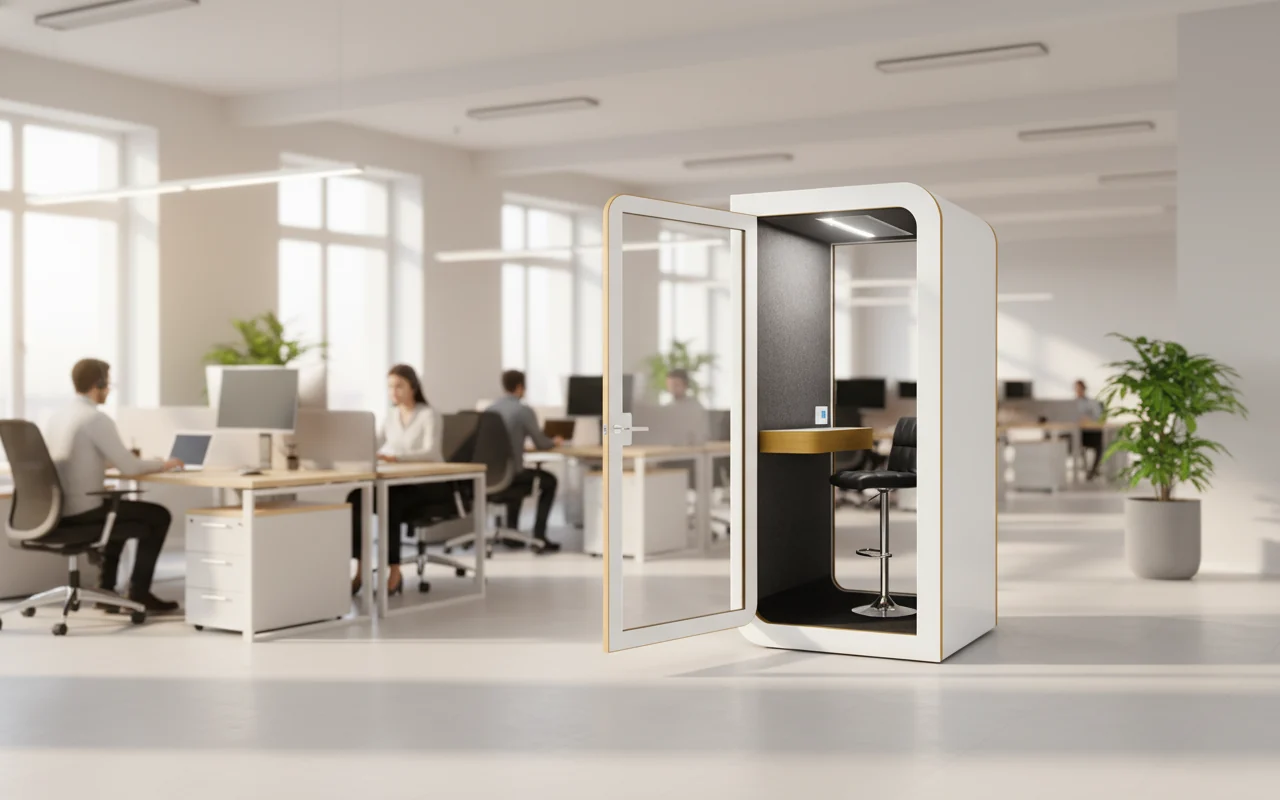
A walk across any large IT services floor at eleven in the morning tells you everything you need to know about what changed. There are people on calls. Not one or two of them, the way it was on a similar floor five years ago. Most of them. Their headsets are on. Their cameras are on. They are talking, sometimes loudly, often confidentially. The acoustic load on that floor is multiples of what its designers planned for.
This is the quiet shift that workplace teams across the industry are still digesting. The open-plan office was not built for call-heavy work. It was built for heads-down work with the occasional huddle. Both ends of that assumption have moved.
What actually shifted
Three changes overlapped. The pandemic normalised video-first collaboration. Distributed delivery teams became the default, which means every working hour is also a synchronous coordination hour with someone in another time zone. And the type of work the services industry sells has moved further up the value chain, which means fewer “ticket closure” hours and more “client conversation” hours.
The result is that an engineer in 2018 might have spent 90 minutes a day on calls. The same engineer today spends three to four hours. Multiply that by a 200-seat floor, and the acoustic load is on a different order of magnitude than the original design ever contemplated.
The honest assessment many facilities teams arrive at, often after a workplace satisfaction survey full of complaints, is that the floor itself needs to absorb that change. You can give everyone better headsets, run an awareness campaign about “indoor voices”, and politely ask people to take calls in the cafeteria. None of these fix the underlying mismatch between the floor’s design intent and its current use. A single soundproof booth deployed near the loudest desk cluster delivers more measurable relief than any of those soft interventions.
The headset is doing less than people think
A common assumption is that good noise-cancelling headsets solve the problem from the speaker’s side. They partially do. The speaker hears their counterpart better, and the algorithmic mic suppression keeps a lot of background office noise out of the call from the speaker’s end.
What headsets cannot do is contain the speaker’s own voice. The colleague at the next desk still hears the speaker clearly, because a headset does nothing about that direction. On a floor with twenty simultaneous calls, the open-plan environment becomes a chorus. Concentration work becomes harder. People who are not on calls migrate to cafés, breakout rooms, or just home — anywhere that resembles a quiet room. A single soundproof booth on the floor swallows one conversation completely, which is why the impact on perceived noise is non-linear once a few of them are in place.
This is the moment where the conversation about soundproof office booths tends to start, because containing the speaker’s voice is exactly what a booth does. The booth is the missing element the original open plan never specified.
How facilities teams are responding
Workplace and facilities leads at larger organisations are reaching for a small set of tools. Acoustic ceiling treatments help with general echo but not with speech leakage. Greenery walls do almost nothing acoustically despite the marketing. Carpet helps on hard floors. None of these address the central problem, which is that every call needs to happen somewhere the call cannot be heard from outside.
The intervention that does address the central problem is to add small sealed rooms. Built rooms are expensive, slow, and require landlord approval. Freestanding booths — single-person phone booths and slightly larger meeting booths for two-to-four people — are fast, modular, and treated as furniture under most Grade A lease structures. A properly specified soundproof booth doesn’t just absorb the call, it relocates it out of the shared acoustic field entirely, which is the part headsets and ceiling tiles cannot do. That trade-off is why the booth category has grown so quickly on modern floors in the last few years.
A note on perception
There is a soft cultural piece to this that workplace teams sometimes underestimate. On a typical floor, the people most affected by noise are often the most senior individual contributors who are doing focus work, while the people generating the noise are often customer-facing or junior staff doing required call-heavy work. Asking the noise-makers to be quieter, without giving them somewhere to go, can land as a class signal. Adding booths is the cleaner response, because it gives the call-makers a respectful place to make the call. Even with a soundproof booth at every cluster, the cultural framing matters; the kit only works if people feel allowed to use it.
Frequently asked questions
How loud is a typical IT services floor compared to a few years ago? We don’t have a single reliable industry-wide dataset to cite, and we’d rather not invent one. What workplace managers report consistently is that the subjective load has grown sharply, and that the number of complaints about noise has risen across the last three workplace survey cycles.
Are noise-cancelling headsets a substitute for booths? For the speaker’s perception of the call, partially. For the colleague at the next desk, not at all. Booths handle the part headsets cannot.
Is the issue worse in certain industries? Financial-services captives and customer success teams generate the highest call density. Engineering-heavy teams generate less. Both, however, have moved toward more synchronous collaboration over the last several years.
Can lower partitions help? They reduce visual openness without solving the acoustic issue, and tend to be unpopular. Most teams prefer to keep the floor visually open and add booths for the moments that require privacy.
Expert view
“What changed isn’t the office, it’s the work. The same floor that comfortably held a delivery team five years ago now needs to hold a delivery team plus an always-on coordination layer. The booth fills that gap better than anything else we have tried at scale.”
— Workplace consultant (illustrative quote)
What to do next
If you are a workplace or facilities lead noticing a rising tide of noise complaints, the right first step is to count. Spend a working day mapping how many calls happen, where they happen, and how often someone walks somewhere else to take one. The answer almost always points at a booth programme.
If you would like a sounding board, get in touch. We are happy to talk through what a sensible first deployment looks like for your floor.