Office cubicle, modern alternative
The partitioned desk was right about one thing
The cubicle gets a lot of abuse, most of it deserved. But the underlying idea — give each person a small enclosure — was correct, and modern booths carry it forward.
About this guide
What the original cubicle got right, what it got wrong, and why the acoustic booth has replaced it on most modern floors as the answer to the same underlying problem.
What the cubicle got right
The original 1960s cubicle concept was a response to a real workplace problem: the open bullpen of typists and clerks did not give people enough cognitive space to do focused work. The cubicle introduced partial enclosure, personalisation, and a small zone of acoustic relief. Workers got somewhere to think.
The office cubicle's failure was not the idea. It was the execution. By the 1990s, real estate cost pressure had shrunk office cubicles to claustrophobic boxes, partitions had grown taller than necessary, and the personalisation feature was actively discouraged. The result was a generation of office workers who associated the word "office cubicle" with corporate misery, which is fair.
The open-plan swing
Much of the global tech sector skipped the cubicle phase almost entirely. The big captives and services majors of the 2000s built open-plan floors from the start, modelled on Silicon Valley aesthetics. Long benches, no partitions, lots of natural light. It looked modern. It worked, for a while, because the work itself was different: heads-down coding, fewer synchronous calls, smaller distributed teams.
That stopped being true sometime around 2018, and the pandemic finished the job. The open-plan floor we built for a quieter kind of work is now asked to host the audio traffic of a global call centre, on top of the original heads-down work. Neither task gets done well.
The booth as the modern cubicle done right
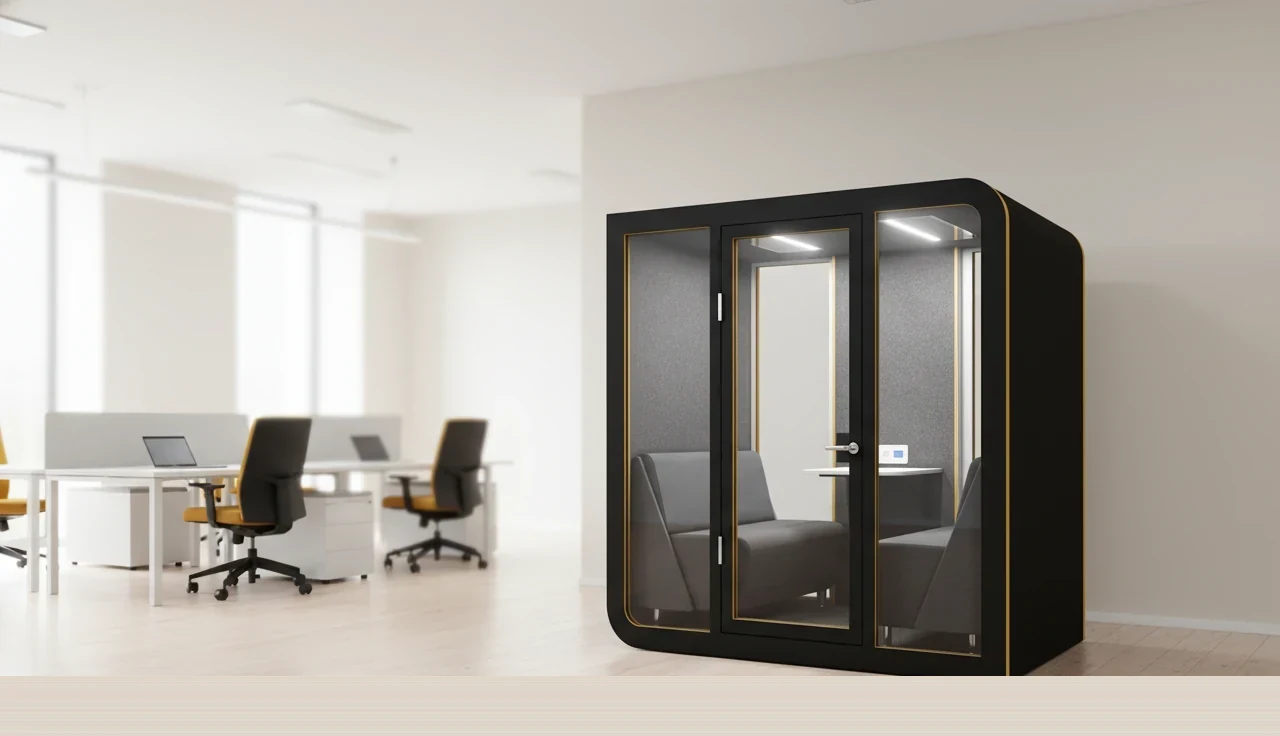
An office booth is, conceptually, the office cubicle redone with everything we learned. It gives each person a small enclosure when they need one, but it is not assigned. You don't sit in it all day. You walk in, take the call, walk out, and the next person uses it. The enclosure is acoustic, not visual: the floor still feels open and bright, and the booth is what handles the moments that need to be private.
In a way it is a more elegant solution than the cubicle ever was, because it separates the two needs the cubicle tried to combine. Visual openness stays on the open floor. Acoustic privacy moves into a dedicated room. Each design solves one problem instead of compromising both.
When a booth replaces a cubicle row
Some older financial services offices and government-adjacent workplaces still have rows of half-height partitioned desks. When these get refurbished, the most common modern intervention is to remove the partitions, restore the open bench, and add a cluster of phone booths and one or two duo pods. The footprint stays the same. The acoustic performance goes up. The aesthetic moves from 1995 to current.
The hybrid-work argument
Hybrid work strengthens the booth argument and weakens the cubicle one. If only a fraction of your team is in the office on any given day, assigning each person a partitioned cubicle is a waste of real estate. Shared seating with on-demand booths makes more sense economically and matches how people actually want to use the space. The cubicle assumed your seat was yours. The booth assumes the floor is shared, and only the moment of privacy is yours.
Frequently asked questions
Are cubicles ever the right answer today?
In specific compliance-heavy environments, partitioned permanent seating still makes sense. For most modern offices, booths combined with open benching is a more honest layout.
Can a booth feel like a cubicle (i.e. claustrophobic)?
A well-designed booth is small but uses light, glass on one side, and ventilation to feel spacious for the duration of a call. A poorly designed one feels like a cupboard. Visit a working installation before you buy.
Do booths take up more floor space than cubicles?
Per-person, no. A floor of open benching plus a sensible number of booths typically uses less square footage per seat than the same headcount in cubicles, because the booths are shared rather than assigned.
Is the cubicle making a comeback?
There are aesthetic experiments with "modern cubicles" in some workplaces, but the broader trajectory is firmly toward open benching plus booths, not toward partitioned individual seats.