
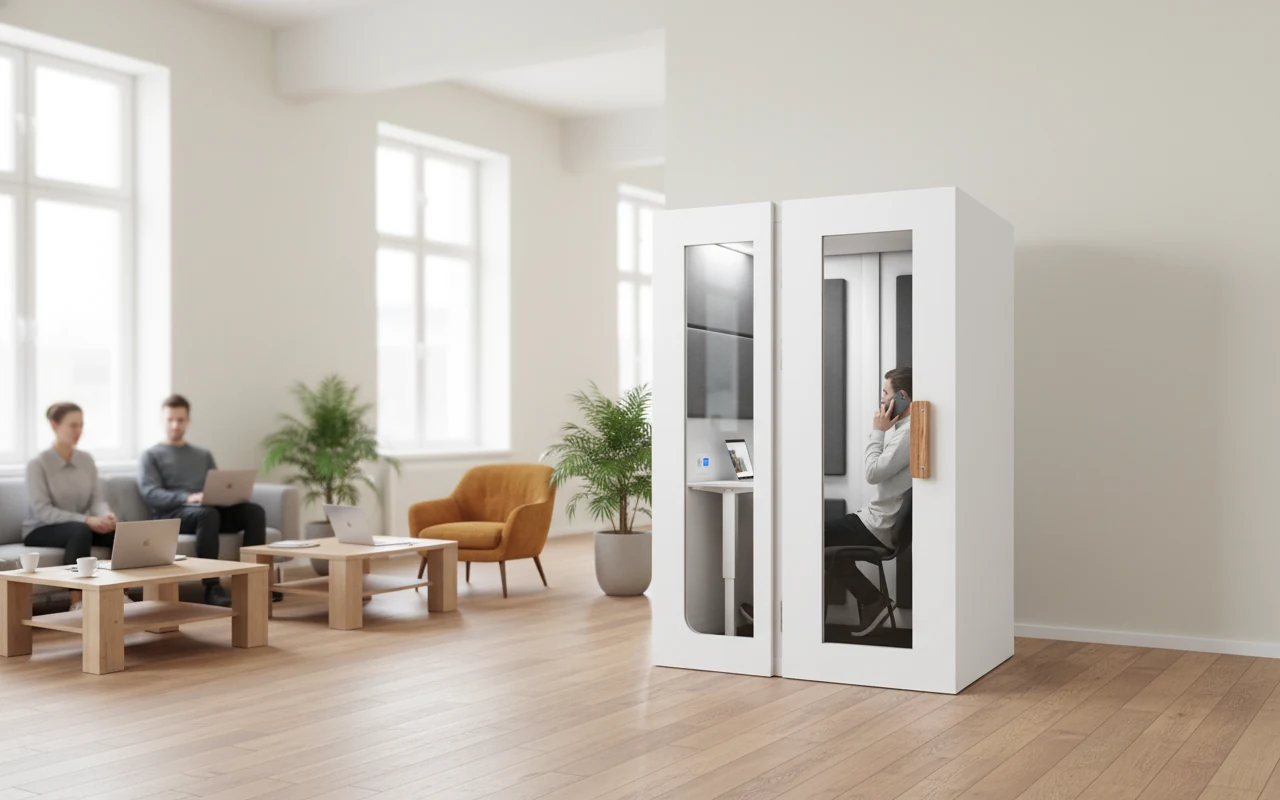
Single-person booths
The single-person pod, sized for modern office floors
The single-person booth is the workhorse of the category. When single-person pods are the right answer, how many you need, and where to place them.
About this guide
A buyer-side look at single-person phone booths — when they are the right answer, how many a floor of a given size actually needs, and the placement rules that decide whether they get used.
The single call problem
Most offices buy their first booth to solve a single, narrow problem: someone needs to take a call without leaking it into the open floor. It is almost never a scheduled meeting. It is a recruiter ringing a candidate back, a manager taking a quick one-on-one, a developer joining a stand-up because the conference room is full. These calls are short. They happen many times a day per floor. They cannot be batched.
A single-person phone booth is the right form factor because it is small enough to deploy in numbers, fast enough to enter and leave, and acoustic enough that the call lands properly. A larger meeting booth — what some catalogues call a meeting pod — is overkill for this job and will end up underused.
How many phone booths a floor actually needs
The ratio facilities teams converge on is roughly one phone booth for every 12 to 15 seats, in a typical services IT environment. Adjust upward for sales, recruitment, customer success or regulated-industry teams; adjust downward for engineering teams that work mostly heads-down. The honest test is whether anyone on your floor is currently walking 30 metres or more to find somewhere quiet to talk. If yes, you are under-provisioned.
A common error is to install two booths "to see how it goes" on a 200-seat floor. They get used immediately, a queue forms, the booths look popular but in reality the problem is not solved. The booth programme has to be sized to absorb the actual call load, not signal goodwill. When buyers compare phone booths for office floors of similar size, the count is usually the variable that explains adoption, not the brand on the door.
Placement that gets used
The rule is short walking distance. A booth that is more than about 15 metres from the desk neighbourhood it serves stops being the default and starts being the backup. People will take the call at their desk and apologise to whoever is sitting next to them, which is exactly the situation the booth was bought to fix.
The best layouts put a small cluster of two or three phone booths inside each major desk neighbourhood, rather than a single line of booths along a wall. The two-or-three cluster also handles the "all booths in use" moment, which is more common than it sounds in a recruiting-heavy or customer-facing team.
Call quality is mostly not about the booth
A common procurement question is whether a booth needs a specific kind of microphone or speaker built in. In practice, modern offices use a headset that the employee already has, paired with a laptop. The booth's job is acoustic isolation, not audio capture. A booth that tries to be a videoconferencing endpoint usually ends up doing both jobs less well than two separate products.
The one piece of integration that does matter is power. Inside the booth, a person needs at least one accessible mains socket at desk height for laptop and headset charging, plus a small surface to put the laptop on. Booths that hide the power outlet behind a panel get marked down by anyone who has ever taken back-to-back calls. A serious vendor of phone booths for office use will treat the socket layout and the cable-run inside the cabin as design decisions, not afterthoughts.
Standing, sitting, or perching
Phone booths come in three internal configurations. A standing booth holds a person upright with a small ledge for the laptop. A perching booth has a stool-height seat that supports a 15-to-25-minute call without inviting a marathon session. A seated booth has a proper chair and a small desk, comfortable for a 45-minute call. Most floors do best with a mix that leans toward perching, since the typical call length in a busy office is well under 30 minutes.
Frequently asked questions
Can two people use a phone booth together for a quick chat?
It is possible in a pinch but not what they are designed for. A duo pod is the right answer if two-person quick chats are common on your floor.
Do phone booths come with a phone?
No. The name is historical. Modern booths are designed for calls made on a personal device or laptop with a headset, not a landline.
How long can someone reasonably stay inside?
A well-ventilated booth handles a 45-minute call comfortably. Beyond that, air quality and comfort start to matter, and a pod or meeting room becomes the better choice.
Are there booking systems that work with phone booths?
Many offices that use platforms like Skedda or Robin add booths as bookable resources. For short calls though, a first-come basis tends to work better than a booking layer that adds friction.
Do they need fire-safety approval from the building?
Most landlords accept them as furniture provided the materials meet fire-retardant standards. Ask your vendor for the relevant material certification before deployment.