If you started your career in an American office in the 1990s, you remember cubicles. Grey fabric walls, a chair-height entry, a calendar pinned to one side, a family photograph on the other. The classic office cubicle was the workplace symbol of an entire generation. It was also, by the time everyone had one, widely disliked.
Many markets did not really go through that. The big IT services build-out of the 2000s in many regions skipped the cubicle phase and went straight to open-plan benching, modelled on Silicon Valley aesthetics rather than the older corporate American template. That has consequences for how the office booth category lands today, because we are not undoing a cubicle layout. We are upgrading an open-plan one.
The cubicle, briefly defended
The 1960s original cubicle, designed by Robert Propst at Herman Miller, was an idealistic product. The goal was to give individual knowledge workers a measure of enclosure and personalisation in the midst of the corporate bullpen. The execution went wrong: budgets shrank the cubicles, partitions grew, and personalisation got discouraged. By the time the cubicle entered popular culture, it stood for everything wrong with corporate life.
The underlying instinct was correct, though. Individual focus work benefits from a small zone of acoustic and visual separation. The cubicle just delivered that badly, by fixing the enclosure to the person rather than the task.
The open-plan inheritance
When tech firms built their first big captive floors across major office markets in the 2000s, the dominant reference design was the open-plan Silicon Valley campus. Long benches, no partitions, exposed-services ceilings. It looked confident and modern. For the work being done at the time, mostly heads-down development, ticket closure, and small-team huddles, it worked well enough.
The aesthetic decision baked in an assumption: that focused individual work did not need its own room. That assumption has aged.
What the booth changes
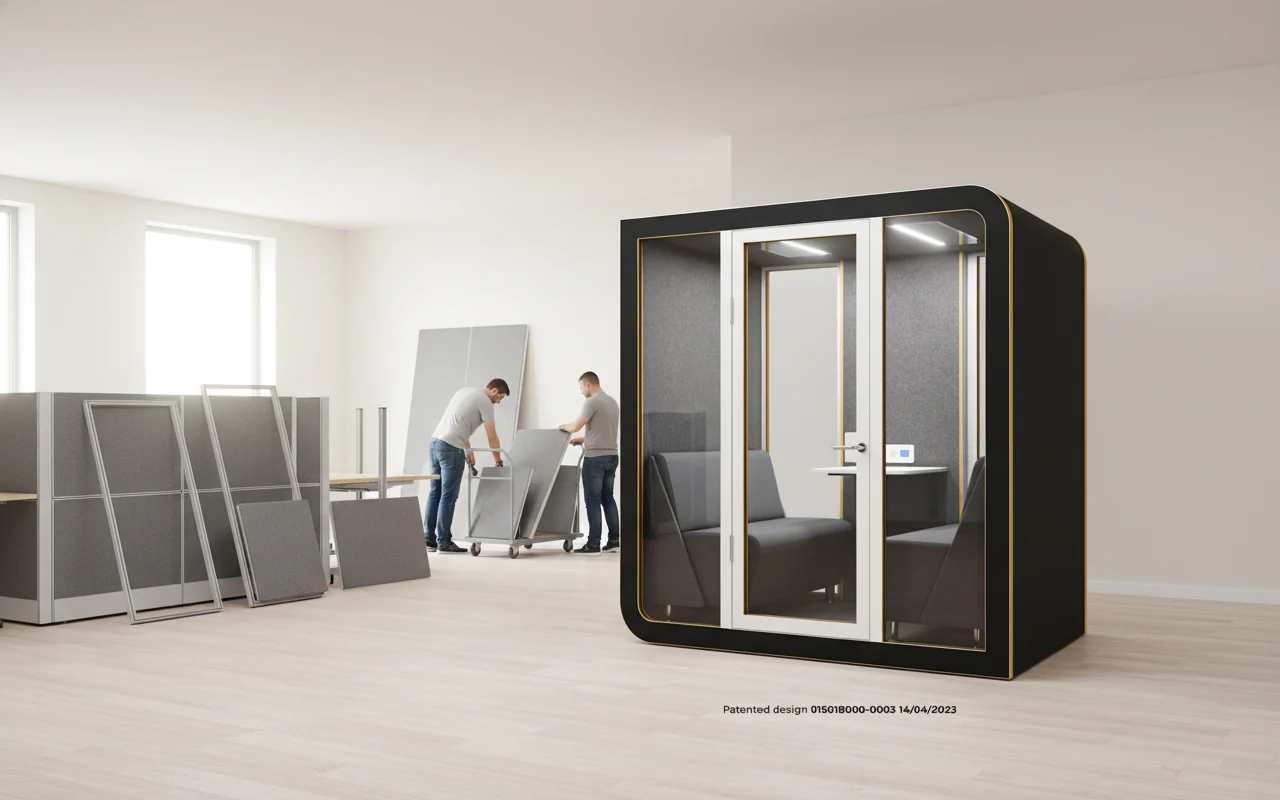
The booth is, in a way, the cubicle rebuilt from scratch with everything we learned. It gives each person a small enclosure when they need one, but the enclosure is not assigned. You walk in, take the call, walk out. The enclosure is acoustic rather than visual: the open floor stays open and bright, and the booth handles the moments that need to be private.
This decoupling matters. The cubicle tried to solve visual openness and acoustic privacy with the same design element, and compromised both. The modern open-plan floor with booths solves them separately. The open bench delivers visual openness. The booth delivers acoustic privacy. Each design solves one problem instead of half-solving two. What the cubicle solved that booths don’t is permanent personalisation, and most modern teams have decided that trade is worth making.
If you are exploring the category, our overview of acoustic pods is a sensible starting point. The shorter version is that there are four meaningful formats, and most floors need a blend.
What open-plan offices kept that older layouts didn’t
There is one thing the open-plan tradition kept that the cubicle never had: a strong sense of the floor as shared space. Lunch rooms, common areas, and the visual continuity of an open layout reinforce that. Booths, used well, sit inside that tradition rather than against it. A booth is a temporary private moment inside a shared environment. It does not signal “this is your territory” the way an assigned cubicle did.
That cultural fit is a quiet reason booths have taken hold on modern floors as quickly as they have. They are not a step backwards toward partition. They are an enhancement to an open layout that everyone already prefers. European-origin vendors in this category, Silentbox among them, tend to lean into that framing in their own product literature, presenting the booth as an open-plan accessory rather than a return to enclosure. When the office cubicle disappeared, the floor did not lose a layout pattern so much as it lost a quiet zone, and the booth is the cleanest way to bring that zone back without rebuilding partitions.
Frequently asked questions
Did any of these offices have cubicles? Some did, especially financial-services back offices and government-linked workplaces. But the dominant template for tech, services and modern captive offices was open-plan from the start.
Is the cubicle making a comeback? There are aesthetic experiments in some Western markets with “modern cubicles”, but in most regions the practical movement is firmly toward open benching plus acoustic booths.
Are booths a fad? They are a specific response to a specific problem: too much synchronous call traffic on floors not built for it. As long as hybrid work and global delivery patterns continue, the underlying problem is not going away, and neither is the response.
Will the next workplace shift be away from booths? Possibly toward different booth formats, smaller and more numerous on some floors, larger and fewer on others. The basic concept of a small sealed room inside an open floor seems durable.
Expert view
“Most workplace clients I speak with have never had a partitioned office. They are not nostalgic for one. The booth is presented to them as an addition to an open floor, not a return to a layout they remember unfavourably. That changes how the conversation goes.”
— Interior architect (illustrative quote)
What to do next
If you are planning a refresh of an existing open-plan floor, the cheapest improvement you can usually make is to add a sensible booth programme rather than rebuild the layout. Walk your floor at peak call time and count the moments where someone is taking a call at their desk because there is nowhere else to go. That count is the demand signal.
When you are ready to spec a programme, the office booths page on this site is a fair next read.