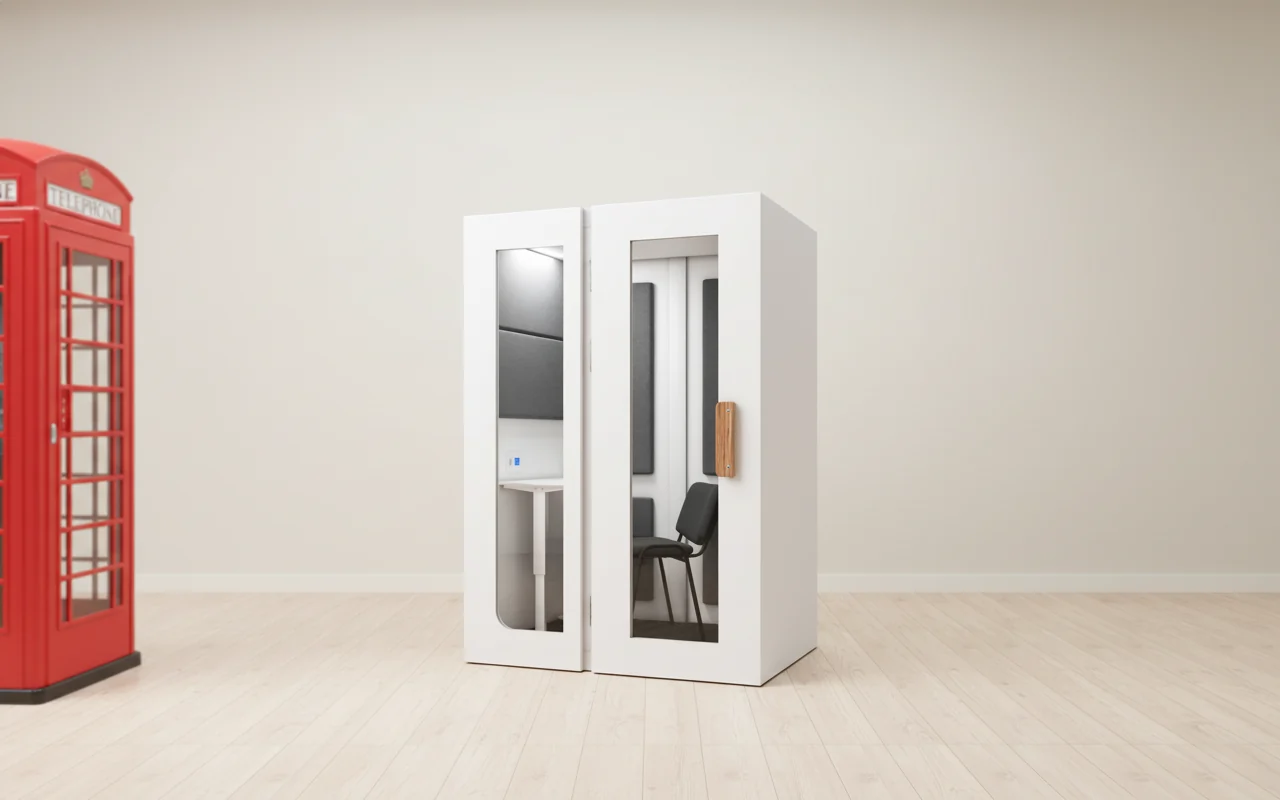
The word “telephone booth” is one of those workplace terms that carries more history than meaning. The thing it originally described, a coin-operated public phone enclosed in a small glass-and-metal box, almost vanished from most streets by the time the people now buying office booths started working. Yet the word stuck to a new product, and the mismatch tells you something interesting about how workplaces change.
A short history of the booth
The original telephone booth was a public utility object. You walked up to it on a footpath, dropped a coin, made a brief call. Its job was twofold: to weatherproof the equipment and to give the caller a measure of privacy from the people walking past. Acoustic isolation was a side effect of the small enclosed shape, not really the design goal.
By the early 2000s the public phone had collapsed under the weight of mobile telephony. Public-phone operators faded out across that decade. The booth itself disappeared from streets in most cities. The word, however, had become a shorthand for “a small space for one person to take a call”. The shape stayed in the cultural memory even after the technology vanished.
The workplace rescue of the word
Sometime in the 2010s, workplace designers started using “phone booth” or “telephone booth” to describe a new kind of office furniture. The new product was, in effect, a small sound proof room dropped freestanding inside an open-plan office. The acoustic isolation that had been a side effect of the street booth’s shape became the actual design intent. The phone, ironically, was no longer part of the product at all. People walked in with their own mobile or laptop, made a call, and walked out.
This is the version of “telephone booth” most workplace buyers mean today. It is a small enclosure for one person, designed for a short call. It does not have a phone in it. It does not have a slot for coins. It is, in design terms, a piece of office furniture descended from a street object that no longer exists.
Why the language matters
Terminology shapes how buyers think about a category. The “telephone booth” framing emphasises the single-person, short-call use case, which is correct for one part of the product family. It can underspecify the larger formats, like duo pods and four-person meeting pods, which serve a different job. A facilities team that walks into a vendor conversation asking only for “telephone booths” sometimes ends up under-ordering on the larger pod formats, because the word does not naturally point toward them.
The more accurate umbrella term is “office booth” or “acoustic pod”, with “phone booth” as one specific size within that family. Some architects describe the larger formats as an acoustic room rather than a booth, which is closer to how facilities teams should think about them when sizing a floor. The street-object lineage is fine to acknowledge in conversation, but it should not drive the spec.
What this tells us about the workplace
The interesting thing about the survival of the word “telephone booth” into the modern office is that it captures a real continuity. The reason we have these objects now is fundamentally the same as the reason we had street phone booths in 1955: people need to make calls, and they need a small private space to make them in. The mobile phone solved the first half of that problem brilliantly. It did not solve the second half. The booth, in its new form, is what does.
So when a workplace manager in a corporate tech park orders a “phone booth”, they are buying a much more sophisticated product than the 1955 version. But the underlying human need has not moved. Privacy for a conversation remains one of the basic infrastructures of working life. The only thing that changes is where, and how, we deliver it.
Frequently asked questions
Is “phone booth” the same as “office booth”? Phone booth is one size within the office booth category. Office booth is the umbrella term covering single-person phone booths, duo pods, and larger meeting pods.
Does a modern phone booth come with an actual phone? No. People bring their own device. The booth provides power, light, ventilation and acoustic privacy.
Why do we still call them “telephone booths” if there is no telephone? Language is sticky. The word survived the disappearance of the original object because it described a recognisable shape and use case, and a new product fit that description.
Is there a more technical name for the category? “Acoustic pod” is more common in architectural specifications and on European vendor datasheets. “Office booth” is more common in everyday procurement language.
Expert view
“The word matters because it sets the buyer’s expectations. People who use the term ‘telephone booth’ often mean the smallest format. People who say ‘pod’ usually mean something larger. A good vendor conversation starts by clarifying which one the buyer actually needs.”
— Workplace strategy consultant (illustrative quote)
What to do next
If you are starting a booth specification and want to avoid undersizing your order, treat “telephone booth” as one of several formats rather than the whole category. Our office booths overview lays out the four formats that actually exist on modern floors.
For the practical sizing exercise, the phone booths for office page covers single-person ratios in detail.