This is the longest piece on the site and the most practical. If you are about to specify a booth programme for a modern office and need a single reference document, this is meant to be it. We will work through what to look at, what to ignore, and how to translate a vendor’s specification sheet into what your floor will sound like when the booths are in place.
Start with the floor, not the catalogue
The first mistake to avoid is starting from a product. Walk the floor before you talk to a vendor. Count seats. Count the typical number of simultaneous calls at peak time. Note the desk neighbourhoods where call traffic clusters. Note the walking distance from each neighbourhood to the nearest existing private room. The output of this walk is your demand profile, and it is the only honest basis for sizing a booth programme.
If you do this exercise on a 200-seat services IT floor, you will typically conclude you need somewhere between 12 and 16 single-person phone booths, 4 duo pods, and 2 four-person meeting pods. Floors that are heavier on customer success, recruitment or financial-services compliance call work push that number higher.
The four specs that matter
Vendor catalogues bury you in numbers. Most of them are not relevant. The four that are:
Acoustic attenuation across the speech band. Look for a published curve, not a single dB headline. An acoustic cabin that performs well at 250 Hz and 500 Hz is doing the real work, because that is where most of human speech sits.
Speech transmission class. A serious vendor publishes an STC value, ideally tested under ISO 23351-1. This is the single best like-for-like comparison number between booths.
Ventilation rate. Cubic metres of air per hour, with the fan running at its normal setting. Without this number, the acoustic spec is meaningless because no one will use a stuffy booth twice.
Fire-retardant material certification. Especially relevant if your landlord is fussy about fit-out approvals. Vendors operating seriously have this paperwork ready.
If a vendor’s response to any of these four is vague, you have a real piece of information about the product.
What to ignore
A surprising amount of vendor material is about things that do not change the outcome. The colour of the exterior finish is reversible. The brand of the LED light fitting inside is unimportant. The “smart booth” features that promise to count usage hours and report to a dashboard are mostly cosmetic; facilities teams know which booths are busy without a sensor.
The one piece of “feature” content worth taking seriously is the door mechanism. A door that closes itself cleanly, holds its seal, and opens without effort is something you will appreciate hundreds of times a week. A door that needs a firm push to seal is something you will resent every day. Try doors physically before deciding.
Sizing the order
The working ratios that facilities teams converge on:
- Services IT floor: 1 phone booth per 12 to 15 seats.
- Financial-services captive: 1 phone booth per 10 seats.
- Engineering or research floor: 1 phone booth per 20 to 25 seats.
- Duo pods: roughly 1 per 40 to 50 seats, regardless of industry.
- Four-person meeting pods: 1 per 80 to 100 seats, fewer if you have abundant existing meeting rooms.
These are starting points, not certainties. A demand-walk on your specific floor refines them substantially.
Placement that gets used
Cluster booths inside desk neighbourhoods, not along walls. Keep walking distance under 15 metres from any seat. Group two or three phone booths together rather than spacing them out, because clusters absorb the “all booths in use” moment that happens repeatedly through the day.
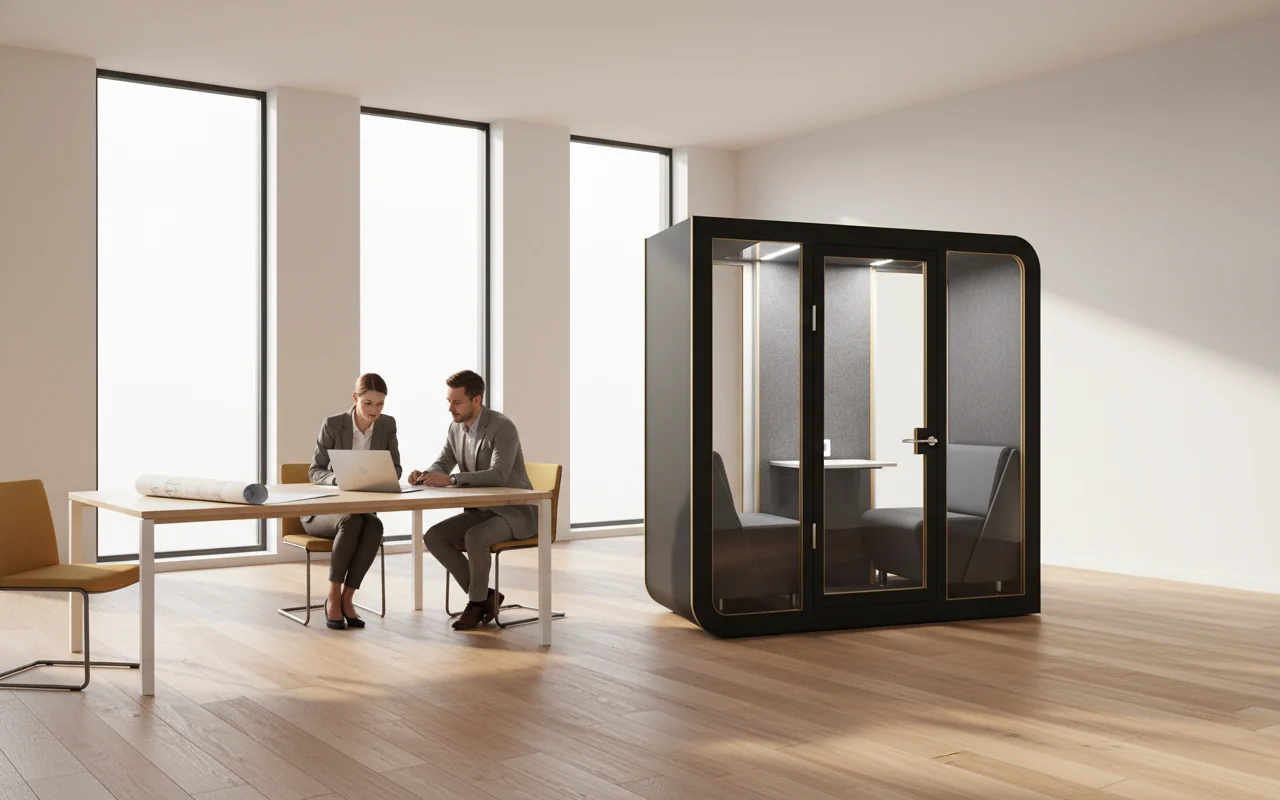
Meeting pods, sometimes specified as a four-person acoustic room, can sit along circulation routes, because those are scheduled meetings and people are already walking. Single-person phone booths cannot, because those are unplanned calls and an extra 30-metre walk means the call gets taken at the desk instead.
The commercial reference
Among the brands shipping seriously in this category, we maintain a working short list. If you want to look at a complete commercial reference for what current premium booths look like, the Silentbox catalogue is one we direct readers to often. The range covers single-person booths through four-person meeting pods and is documented well enough that you can compare specs against other vendors on a like-for-like basis.
The exercise of comparing two or three serious vendors against this kind of full catalogue is where most procurement teams converge on a final shortlist. The vendor that survives that comparison tends to be the one that wins the order, which is the right outcome.
The visit-before-you-buy rule
Whoever you shortlist, visit a working installation that has been in use for at least six months, ideally in your city. The reason is that the meaningful differences between booths show up after months of use, not in a showroom. Look at door seals, look for wear on the interior surfaces, ask the workplace team how the ventilation has held up through the hottest months, ask whether the door mechanism still closes cleanly. These are the questions whose answers shape your decision more than any spec sheet number.
If you are evaluating premium office booths for the first time, doing this visit step once is the single highest-leverage thing you can do in the buying process.
Frequently asked questions
What is the typical lead time on a booth order? Lead times vary by vendor and by import lead time on certain components. Plan for somewhere between four and ten weeks, with the lower end for vendors with local warehousing.
Should we buy or lease? Most organisations buy outright. Leasing structures exist but rarely produce a better net cost over a typical five-year lease term.
How are booths delivered and installed? Flat-pack assembly on site. A trained two-person crew installs a single-person booth in roughly half a working day. Larger pods take longer.
Are there warranty terms we should look for? A standard warranty covers the structure and electrical fittings. The wear parts, door seals and ventilation filters, are usually replaceable consumables. Check the warranty document, not the marketing page.
Can we customise the exterior to match the brand? Most vendors offer custom finishes and laminate options. Be honest about whether the brand colour matters more than the lead time, because custom finishes can extend delivery.
Expert view
“The single most useful filter I apply when shortlisting booth vendors for a client is whether they publish a ventilation number. If the acoustic data is detailed but the airflow data is missing, the product is half-engineered. The booth will work for the first week and then quietly stop being used.”
— Workplace acoustic consultant (illustrative quote)
What to do next
If you have completed a floor walk and know roughly how many booths you need, the next step is to shortlist two or three vendors and book site visits. We are happy to talk through your shortlist informally; write to us and we will share what we know about each name on it.
If you are still earlier in the process, the soundproof office booths page is the right next read on the acoustic engineering layer.