There is a small detail you notice when you tour a serious coworking space in any major city. The operator will lead you straight to the phone booths. They will count them out loud. They will tell you how many are on each floor and how they handle peak demand. The booth count has become a leasing argument, and the operators worked this out before the corporates did.
Why coworking got there first
Coworking operators face a particular pressure that corporate workplace teams largely do not. Their tenants can leave at the end of any month. The lease is short. Renewal depends on whether the experience justifies the cost compared to a competitor down the road. Anything that visibly affects daily working life shows up in renewal economics fast.
Phone booths affect daily working life. A startup with five people on simultaneous calls cares deeply about whether they can find a booth in the next 90 seconds. A solo founder taking an investor call cares about whether the booth holds the call without leakage. The booth count, the booth quality, and the wait time at peak become directly tied to whether the tenant signs for another month.
This created a feedback loop in high-density coworking markets specifically. The neighbourhoods with the most concentrated startup and freelancer demand saw operators competing on booth provision earlier and more visibly than the broader corporate office market did. The first thing to look at in phone booths for office settings is the count, and coworking spotted that before most corporates did.
The high-density-cluster effect
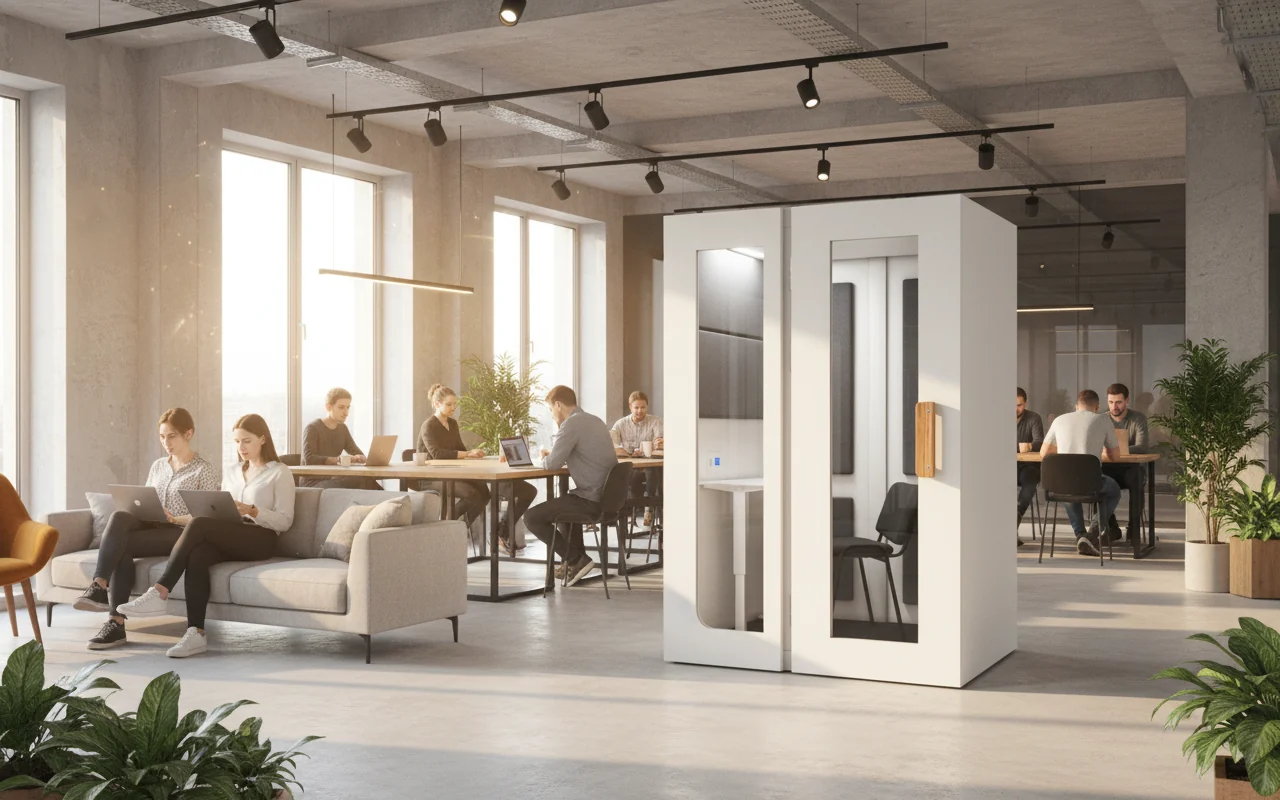
Walk into any of the major coworking spaces along a city’s main commercial spines and you will see the pattern. Booths are not tucked into back corners; they are placed near the main working areas where tenants can see them and grab one quickly. The operator’s tour pitch leans on booth count the way restaurant chains lean on the number of branches. It is a number to brag about.
The reason is competitive. A tenant evaluating two coworking spaces of similar price and similar location will often decide based on the working amenities. Internet speed is the first one. Booth count and quality is now reliably the second. Some operators publish booth-to-seat ratios in their leasing material, which would have seemed strange five years ago.
What corporates can learn
Corporate workplace teams sometimes treat booths as a procurement item, a line in a fit-out budget, and lose sight of the daily-experience point. The coworking sector’s pressure-tested view is the opposite: booths are an amenity, and the amenity quality is felt by every user every working day.
The practical takeaway for corporate workplace teams is to think about phone booths for office deployment the way a coworking operator does. Visible placement. Sufficient count for peak demand. Quality high enough that the experience inside the booth is a small upgrade on the desk, not a downgrade. If the booth is uncomfortable, people will not use it, and the procurement money is wasted.
The booking-system question
A debate that has run inside coworking circles for a couple of years is whether to add a booking layer on top of phone booths. Some operators tried it. The pattern that emerged is interesting: bookings work well for the larger meeting pods, where people can plan the call ahead, and badly for single-person phone booths, where most calls are unplanned and a booking layer adds more friction than it removes.
Most operators settled on a hybrid. Phone booths are first-come, with a soft norm that a single call lasts no more than 30 minutes. Larger pods are bookable. The norms are reinforced more by community management than by software, which is the coworking way.
Acoustic consistency under pressure
The harder problem for coworking operators is that their booth fleet sees several times the daily usage of a typical corporate fleet. A booth in a busy coworking space might be entered 20 times in a working day. Multiply by five working days, by 50 weeks, by five years, and you understand why door seals and ventilation filters are the maintenance headline. Operators who specified higher-end booths from the start tend to spend less on replacement and downtime later.
For corporate buyers in less call-dense settings, the coworking sector’s high-usage testing is genuinely useful field data. A booth design that holds up in a five-year coworking deployment will hold up in almost any corporate setting. Anyone evaluating phone booths for office deployment can read the coworking durability record as a stress test the corporate floor will rarely match.
Frequently asked questions
Are coworking spaces the right place to evaluate a booth before buying? They are an excellent place. Tour two or three busy coworking spaces during peak hours and you will see the booth experience under realistic load.
Do coworking operators buy directly or lease? Most buy directly. Some larger operators have framework agreements with specific vendors for multi-site rollouts.
Is the booth ratio in coworking different from corporate? Generally yes, higher. A premium coworking space might run one phone booth per 6 to 8 seats, which is roughly double the corporate norm. The usage pattern is more bursty and the booth has to absorb peaks.
Why is this most visible in high-density tech clusters? Tech-heavy neighbourhoods have the largest concentration of small and mid-sized companies churning through coworking memberships, which means the coworking market has more competition and more pressure to differentiate on amenity. The dynamic then appears in adjacent markets a year or two later.
Expert view
“Our renewal conversations always come back to the same three things: wifi, coffee, and booths. The first two are table stakes. The third is what tenants actually argue about. The day we under-provisioned booths on one floor was the day we started losing renewals.”
— Coworking operator (illustrative quote)
What to do next
If you run a coworking space and have not formally counted your booth-to-seat ratio at peak demand, that is the first audit to do. Most operators find they are 20 to 30 percent under what their tenants need.
If you are a corporate workplace lead and want to see what a high-density booth deployment looks like in practice, visit a serious coworking operator at 11 a.m. on a Wednesday. The lessons transfer cleanly. Then, when you are ready to spec your own, the phone booths for office page is the right starting reference.