Noise complaints land on HR desks more often than facilities teams realise. They rarely arrive as “the floor is loud”. They arrive disguised as something else: a request to work from home permanently, a comment in an exit interview, a quiet rumour that a particular team is “difficult to sit next to”. The translation between the language of complaint and the underlying acoustic reality is part of the HR role.
What complaints actually say
The most common acoustic complaint at a busy workplace is not phrased as one. It usually shows up as a request to be reassigned to a different desk neighbourhood, a request to attend more meetings from home, or a quiet pattern of arriving early or staying late to do focused work when the floor is quieter. The HR business partner who recognises the pattern can name the underlying issue. The one who treats each instance individually keeps treating symptoms.
A workplace experience survey, run carefully, surfaces this faster. The question that produces the cleanest signal is not “is the office loud?” but “can you do your most important work here without being interrupted?”. The answers come back qualitatively useful even when the dB readings on a sound meter look unremarkable.
The triage problem
HR teams handling noise complaints face a small triage problem. Not every complaint is about acoustic engineering. Some are about a specific colleague who genuinely is too loud, and those need a different response, often a polite one-on-one rather than a furniture order. Some are about a team behaviour, like a recruiting team that runs ten calls in parallel during peak hours. Some are about a real structural issue with the floor.
The skill is in separating these. Once you have done that, the structural pile is what a booth programme addresses. The behavioural pile is what conversations and norms address. The individual pile is what people management addresses. Conflating them sends the problem to the wrong solution. A soundproof booth fixes the structural pile cleanly; it does nothing for the other two, and pretending otherwise wastes the budget.
Where a booth programme fits
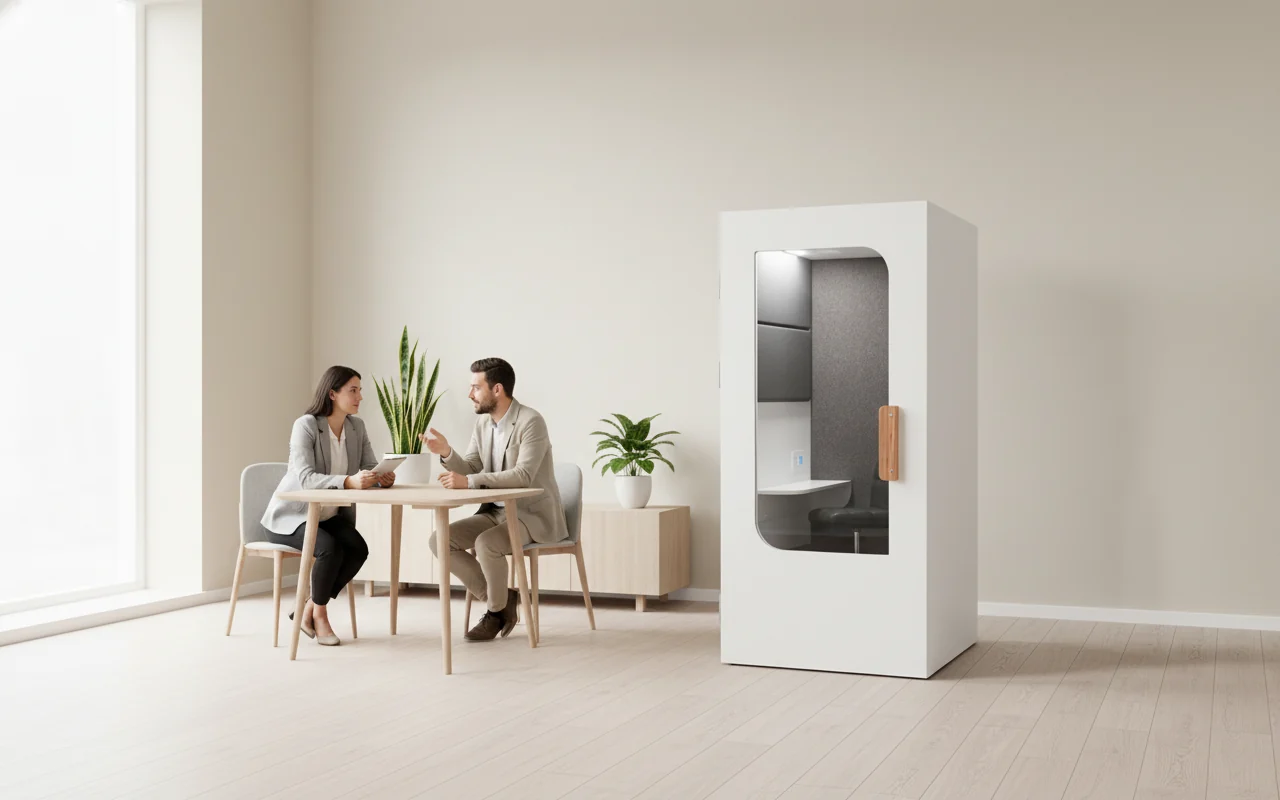
A booth programme is the structural answer. It does not solve every noise complaint, but it solves the specific one where people genuinely need to talk and have nowhere quiet to do it. Once enough booths and a small number of larger quiet rooms exist on the floor, the norm shifts: “take it to a booth” becomes a clean, blameless response that does not single out any individual. The HR conversation gets easier because the option exists.
This is one of the underrated benefits of an acoustic cabin programme that workplace teams sometimes miss when they evaluate the spend on purely acoustic grounds. The booth is also a people-management tool. It gives HR a place to point to when conversations about noise need to happen, and it removes the awkwardness of asking colleagues to be quieter without offering them anywhere to go.
Behavioural norms that work
Once the structural piece is in place, the behavioural piece becomes manageable. The norms that work reliably tend to be soft and specific: a one-page guide pinned in common areas about call etiquette, a clear signal from team leads that booths exist and should be used, and a routine check-in by HR with team managers about how the floor is working. The heavy-handed version, broadcast policies and dB monitoring, tends to backfire.
The most effective single behavioural intervention we have seen is for the senior leadership on the floor to visibly use booths themselves. The moment a vice president takes their next call in a booth rather than at their desk, the norm cascades. The booth becomes a normal piece of office life rather than a remedial measure for noisy juniors. A well-specified soundproof booth used routinely by leadership signals more than any internal memo ever does.
When the complaints continue
If noise complaints persist after a booth programme is in place, the issue is usually one of two things. Either the booth count is still under-provisioned for actual peak demand, or there is a specific behavioural issue on a specific team. Both are addressable. The booth count is fixed by adding more units, ideally informed by an honest demand walk. The behavioural issue is fixed by working with the team’s manager. HR can usually tell which is which by walking the floor at peak time and seeing whether the booths are full or empty. When the answer is under-provisioning, the practical follow-up is to revisit the original vendor — Silentbox or whoever supplied the first wave — and order the second batch against the same spec, so the fleet stays consistent and the maintenance contract does not fragment.
Frequently asked questions
Is it appropriate for HR to flag a noise issue with a specific employee? Sometimes, but only after structural fixes are in place. Asking an individual to be quieter when there is nowhere else for them to take their calls puts them in an unfair position.
How often should we survey for workplace acoustic experience? Twice a year is enough to spot trends. Quarterly is overkill. Annual misses too much.
What if leadership pushes back on the booth budget? The strongest case is usually framed in retention and productivity terms, not in dB reductions. The cost of a single soundproof booth is small compared to the loaded annual cost of even one of the people whose focus time it protects.
Are noise complaints a hidden cause of attrition? They are part of a broader workplace experience picture rather than a single attrition driver, but exit interview data from HR teams suggests they appear often enough to matter.
Expert view
“Most of the noise conversations I have with employees are not really about decibels. They are about whether they feel the office helps them do their job. When the floor has good booths and good norms, the noise conversations get shorter and the attrition conversations improve at the same time.”
— HR business partner, financial services (illustrative quote)
What to do next
If you are an HR lead noticing a rising tide of noise-adjacent complaints, the first step is to confirm whether the floor genuinely has an acoustic issue or whether you have a specific behavioural pattern on a specific team. Both deserve a response, but they deserve different responses.
If the answer is that the floor has a structural issue, the office booths overview and the acoustic booth buying guide are the right next reads. The booth programme is rarely the whole answer to a workplace acoustic problem, but it is almost always part of it.