There is a stretch of weeks every year, usually the wettest part of the season, when office buildings change shape slightly and almost nobody talks about it. The change is small in absolute terms. Door frames swell by a fraction of a millimetre. Acoustic seals compress differently. Roof slabs hold humidity. The cumulative effect on an office’s acoustic performance is meaningful, and the facilities team that prepares for it has a quieter quarter.
This piece is a short maintenance-oriented checklist for the humid season. It is most useful if you run facilities or workplace experience for an office with booths, partitions, and a typical Grade A building envelope. It applies most acutely in coastal and tropical cities where seasonal humidity swings are largest.
What humidity does to office acoustics
Wood swells when humid air gets into it. Metal expands slightly with temperature. Gaskets and seals soften. The end result is that joinery that fit precisely in February no longer fits precisely in July. Doors close differently. Sliding panels run differently. Acoustic seals that compressed cleanly in the dry months now meet a slightly different surface.
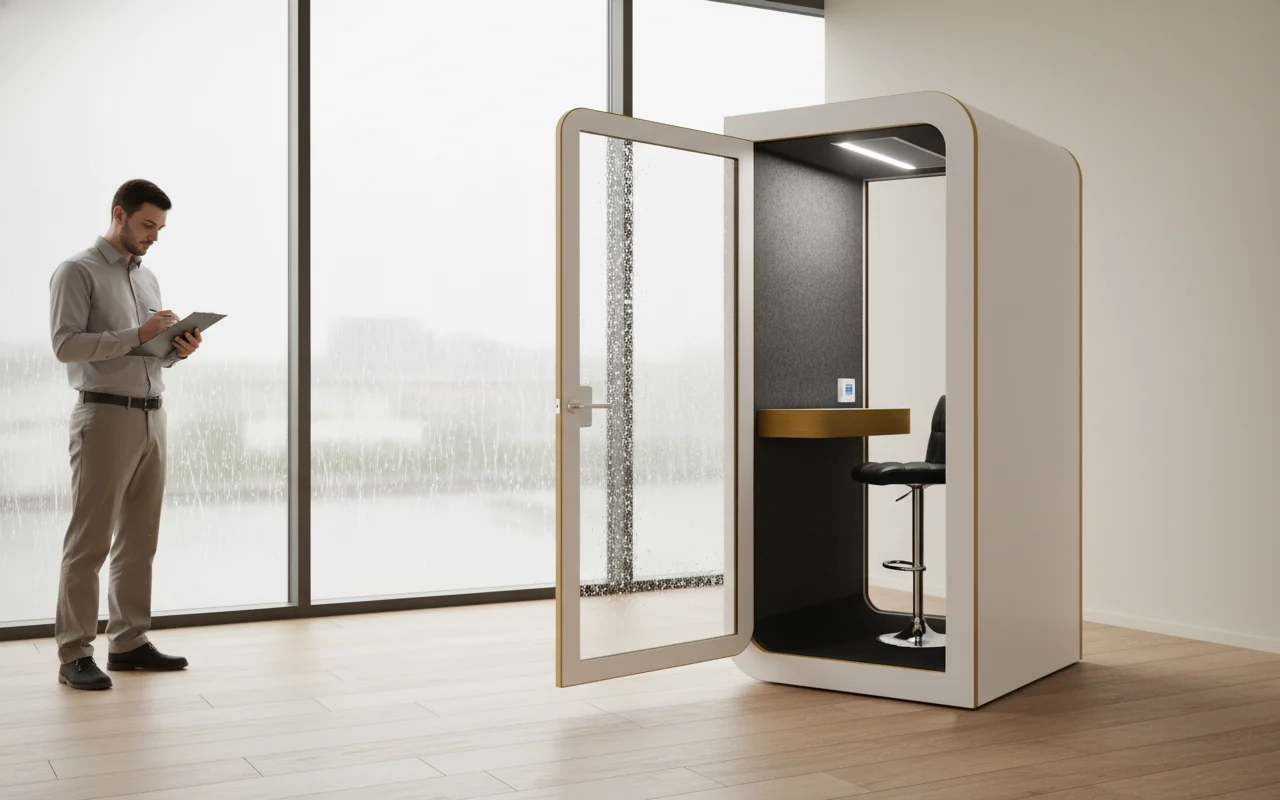
For an office with built rooms, this shows up as a marginal drop in acoustic performance, which is rarely noticeable. For an office with phone booths and meeting pods, the same shift can be more visible, because the booth’s acoustic performance depends on the door seal making a clean contact. A 2-millimetre door alignment shift can produce a small leak at the corner, and the booth’s privacy drops just enough that people start noticing.
Roof slab and heavy-rain weeks
The other seasonal factor is rain noise on the building envelope. Grade A buildings have insulated roof slabs that handle this reasonably well, but the top floor of any building experiences a marked acoustic change during heavy rain. Booths on the top floor are usually fine because the booth itself is sealed, but the floor outside it gets louder, which paradoxically makes the booth feel more necessary during the wettest weeks.
For older buildings or converted spaces with thinner roof construction, the rain-noise effect is larger and worth planning for. We have seen workplace teams in older urban offices simply rearrange their floor to put focus seating away from external walls during the heaviest-rain months.
The checklist itself
Before the humid season begins, ideally in late spring:
- Walk every booth on the floor with the door closed and the person inside speaking at normal volume. Listen from outside at two metres. Identify any booth where the speech is more intelligible than the rest of the fleet.
- Check the door seal alignment visually. A clean seal looks consistent all the way around the door frame.
- Check the ventilation fan and filter. Replace filters that look loaded. Humid-season air carries more dust and humidity, and a clogged filter shortens the booth’s working life.
- Run a brief inspection on any acoustic ceiling panels in adjacent areas. Sagging panels lose effectiveness.
- Confirm that any external building seals around windows on the floor are intact. Window leakage is a common humid-season issue that gets blamed on booths.
During the humid season, ideally monthly:
- Recheck door seals. Re-tune any booth where the seal has shifted.
- Wipe down acoustic panel surfaces. Some panel fabrics hold humidity for a few hours after a particularly wet day, which can dampen the panel’s performance briefly. Drying helps.
- Listen for the ventilation fan sounding different. A fan that suddenly works harder is moving against a clogged filter.
After the humid season, in autumn:
- Run a full re-evaluation of the booth fleet. Wear patterns from the heaviest humidity months become visible in autumn.
- Schedule any seal replacements before the next dry-cycle starts. Seals replaced in autumn hold cleanly through the dry season.
Why facilities teams under-plan for this
The honest answer is that season-specific acoustic maintenance is rarely on the formal facilities playbook. It tends to land as a series of small individual complaints in mid-summer that the team firefights one at a time. A facilities lead who recognises the pattern and runs the pre-season walk in spring saves a noticeable amount of complaint volume across the wet months.
The other answer is that vendors do not always bring this up unprompted. The materials in modern booths are designed to be reasonably stable across humidity ranges, but no material is fully immune, and the cumulative seal-and-frame effect is real over years of use.
What good vendor support looks like during the humid season
A serious vendor includes a humid-season readiness check as part of their annual maintenance contract, usually in late spring. They send a small team, walk the booth fleet, replace any seal or filter that looks close to its replacement window, and document any units that may need a closer look in autumn. Some catalogues — Silentbox is one example we have seen do this — publish their seal-replacement intervals and filter-change cadence in the product documentation itself, which makes the maintenance conversation easier because you are not guessing. If your current vendor does not offer this, ask. It is a low-cost addition and it saves you the harder, complaint-driven repair cycle in mid-season.
Frequently asked questions
Does humid-season maintenance affect every booth equally? No. Booths in areas with more direct air movement, near major doors or windows, see slightly more humidity exposure. Top-floor booths see more roof-related effects.
Is there a permanent fix? Materials choice helps. Modern booths use polyester acoustic felts and magnetic or compression seals that handle humidity better than older materials. But no commercial product is immune. A small annual rhythm of seal checks is the realistic answer.
How long should a door seal last? In normal conditions, two to three years before replacement is the typical range. In a heavy-humidity, high-usage environment, sooner. The vendor’s spec sheet usually has a number.
Is this an issue in dry-climate cities? Less so. Inland and high-altitude cities have milder humidity swings than coastal or tropical ones. The principle still applies, just to a smaller degree.
Expert view
“The thing facilities teams in humid-climate cities learn the hard way is that the wet season is not a single event you wait out. It is a 100-day stretch where the building behaves differently. Treating it as a maintenance season rather than a weather inconvenience is the right framing.”
— Senior facilities manager (illustrative quote)
What to do next
If you have not yet walked your booth fleet ahead of the humid season, late spring is the right month to start. The walk takes a couple of hours for a typical office floor and saves repeatedly more time than it takes during the complaint-heavy weeks that follow.
If your current vendor does not offer a humid-season readiness check as part of their service contract, ask for one. A vendor seriously deployed in humid markets should have this on their menu. If they do not, treat that as information about whether they understand the market they are selling into.
For the broader buyer view of how to evaluate a vendor’s market competence, our acoustic booth buying guide covers the questions that matter most.